
P
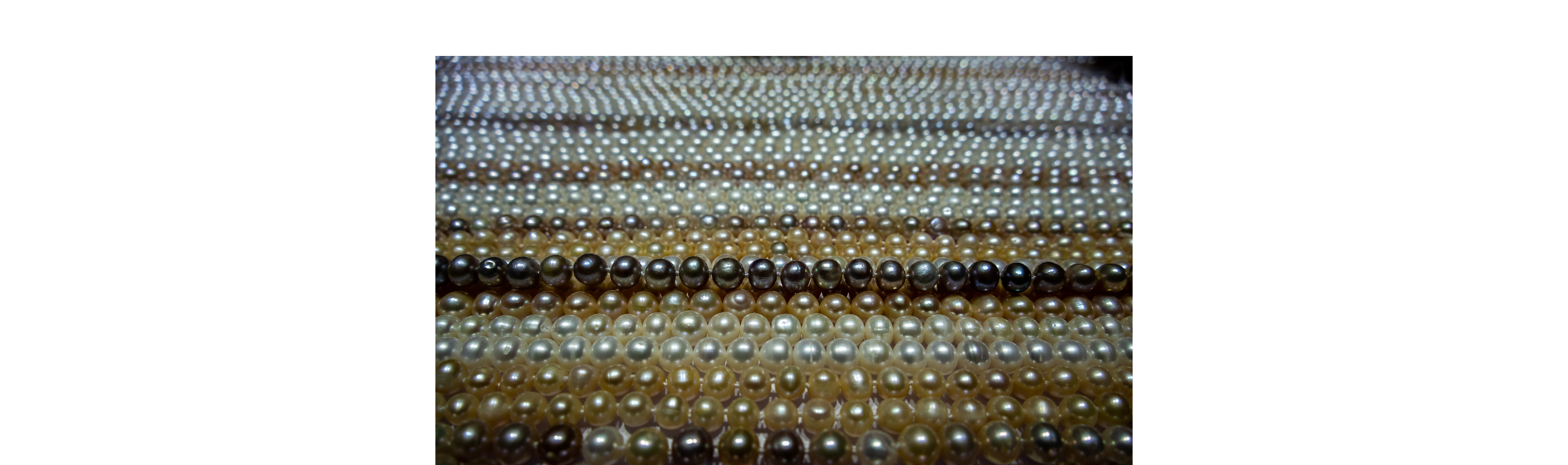




PEARL
Name: derived from the Latin “perla” which is likely a variation of “pirula” meaning “little pear,” referring to the common shape of many natural specimens.
Description: Pearls are an organic gem. Natural pearls are extremely rare. Virtually all pearls today are saltwater or freshwater cultured. The longer the pearl remains within the mollusk, the larger it will become. Pearl shapes are round, near-round, oval, drop, button, baroque, and semi-baroque. The most valuable shape being a symmetrical round or drop pearl.
Types:
Akoya: cultured pearl; typical size range is 6mm to 8mm, but can be as small as 2mm and as large as 11mm. Most have a white to cream bodycolor. Other natural colors include yellow, gray, and blue. Japan and China both produce saltwater akoya cultured pearls.
South Sea: Australia, Indonesia, and the Philippines are leading sources of these saltwater cultured pearls. Myanmar (Burma) and Thailand are also important producers. Typically 8mm to 18mm in size. Most common body-colors are white, cream, and golden (dark brownish yellow), but you’ll see them in other colors, too.
Tahitian: cultivated primarily around the islands of French Polynesia, these saltwater cultured pearls usually range from white to black. Other colors include dark metallic greens and purples. The usual size is about 8mm to 17mm, although larger pearls exist in limited quantities.
Freshwater: cultured in streams, rivers, and lakes. They’re produced in a wide range of sizes, shapes, and colors. China and the United States are the leading sources.
Keshi (Japanese for “poppyseed”) form without being intentionally nucleated in mollusks undergoing pearl cultivation.
Blister Pearls: cultured or natural pearls that form over a solid core inside a freshwater or saltwater mollusk’s shell. The side that faces the shell is flat and lacks nacre.
Mabe: an assembled product consisting of a cultured blister pearl dome cemented to a backing made from mother-of-pearl shell. After harvesting, the nucleus is removed and the hollow interior is usually filled with a material such as epoxy resin.
Color: The color of a pearl is dependent upon the variety of mollusk and its environment. Pearl colors are white, silver, cream, yellow, gold, orange, brown, pink, red, lavender, mauve, black, gray, blue, green, and multi-colored. A pearl’s body color is the main color of the pearl, and it can be modified by overtones (additional colors seen, typically pink, blue, green, purple) or orient (iridescence).
Chemical Composition: composed primarily of aragonite (CaCO3) and conchiolin. Calcium Carbonate/Aragonite.
Treatments: Pearls are often bleached to lighten and enhance their color. Pearls are sometimes dyed.
Bleaching: standard for white pearls.
Pinking: a subtle red dye to enhance “rose” overtones.
Irradiation: to darken freshwater pearls.
Coating: adding a “luster” layer; common in low-quality goods.
Moh's Hardness: 2.5 to 4.5.
Toughness: Good.
Locations Found: Arafura Sea; Australia; China; French Polynesia; the Gulf of California; the Gulf of Mexico; India; Japan; Omanto Qatar (Persian Gulf); the South Pacific Islands; Sri Lanka. Freshwater pearls can be found in the Mississippi River, several rivers in England and Ireland, and streams of Bavaria.
Akoya Pearls are found in Japan and China.
South Sea Pearls are found in Australia, Indonesia, and the Philippines.
Tahitian Pearls are found in French Polynesia.
Freshwater Pearls are found in China, England, Ireland, and USA (Mississippi River; Tennessee).
Cultivation: Historically, freshwater pearls were more accessible to early civilizations than saltwater pearls. The cultivation of freshwater pearls was thought to have begun in China in the 13th-century. In 1893 in Japan, Mikimoto Kokichi started pearl cultivation that successfully produced a perfect round pearl. In the 1920s cultured pearls became commercially important as natural pearl production was declining. Today cultured pearls are grown on freshwater or saltwater pearl farms around the world.
Birthstone: June.
Wedding Anniversaries: 1st (freshwater), 3rd, 12th, and 30th.
Zodiac Signs: Cancer, Gemini.
Historical Associations: Moon; water; wisdom; protection; good luck; good health; wealth; prosperity; money; imagination; fertility; going with the flow; sincerity; integrity; enlightenment; honesty; memory recall; intuition; clarity; peace; love; affection; emotion; patience; elegance; loyalty; purity; innocence; modesty; chastity; to determine right from wrong; anchored in the present; lightning; dragons; daughter.
Historically Used To Treat: hysteria; eye troubles; tuberculosis; cardiac trouble; constipation; balance emotions and hormones; relieve digestive disorders; allergies.
CARE: Do not expose pearls to harsh chemicals. If you use hairspray or perfume, put the pearls on after applying the hairspray or perfume. Perspiration can dull your pearls. Gently wipe pearls with a soft cloth after wearing them to preserve the luster of your pearls. Only use mild soap and mineral water or distilled water to clean your pearls. Do not clean your pearls with brushes, ultrasonic cleaners, or steamers, as they can cause damage to your pearls. Storing pearls in direct sunlight can cause yellowing. Keep away from heat to avoid surface fractures in your pearl.
Imitations: Glass; Plastic beads; fish-scale coatings; Majorica Pearls (glass core with essence).
Synthetics: No “lab-grown” biological pearls exist. Shell Pearls are made from ground-up oyster shells shaped into beads and coated with pearl essence.



PERIDOT
Name: Peridot comes from the Arabic word “faridat,” meaning “gem,” or from the Greek word “peridona,” which means “give in abundance/something that provides richness.” It was known as the “evening emerald” by the ancient Greeks, and the “gem of the sun” by ancient Egyptians.
AKA: Emerald of the Evening; Forsterite; Gem of the Sun.
Description: is usually transparent and comes in a range of colors from brownish or yellowish green to greenish yellow, bright lime greens, and subdued olive greens.
Chemical Formula: (Mg,Fe)2SiO4
Variety: olivine, gem variety.
Color: It gets its color from iron and has a color range from greenish-yellow to yellowish-green to brown-green, lime green, and olive green. Today, the most sought-after color of peridot is a pure, grass-green without any hint of yellow or brown. Peridot may have inclusions of biotite, chromite, spinel, pyrope garnet, and liquid or gas-filled inclusions. Peridot is not normally treated. Occasionally, if fractures are present within the stone, it may be fracture-filled.
Treatments: Rarely treated. Occasionally treated with colorless oils or resins to fill surface-reaching fractures.
Moh’s Hardness: 6.5 to 7.
Toughness: fair to good.
Location Found: Pakistan, Myanmar (Burma), Tanzania, Vietnam, China, Brazil, Kenya, Africa, Australia, Finland, Norway, and the United States of America (Arizona, Hawaii, New Mexico). The oldest source of Peridot is in the Red Sea on the Egyptian island Zabargad (St. John’s Island) which had been given names like “Island of Death” and “Snake Island”.
Birthstone: August.
Wedding Anniversaries: 15th, 16th.
Zodiac Signs: Libra, Capricorn, Leo, and Virgo.
Chakra Associations: Heart; Solar Plexus.
Historical Associations: power; influence; happiness; nobility; generosity; prosperity; good fortune; wealth; love; appreciation; enlightenment; wisdom; secrecy; Pele; protection from evil spirits, enchantments, and night terrors; light; Sun; protection from night terrors; ward off evil spirits; volcano; meteorite; cure jealousy; cure anger; cure spite; abundance; manifestation; increase self-confidence; assertiveness without aggression; trusting your inner light; detaching from outside influences; open the mind to a new level of awareness; release old baggage; release guilt.
Historically Used To Treat: asthma; eyes; digestion; liver; gallbladder; metabolic function; rashes; stomach ulcer pain; stimulate contractions; heart; spleen; lungs; digestive tract.
Care: Avoid abrupt temperature changes, steamers, and acids. Rapid or uneven heat can cause fracturing or breakage. Attacked easily by sulfuric acid, and less easily by hydrochloric acid. Can be attacked over a long period of time by acid perspiration. Never steam clean. Ultrasonic cleaners are risky. Warm, mild soapy water and a soft cloth are safest to use. Store separately in a soft pouch as it can easily be scratched.
Imitations: Glass; Plastic; Synthetic Sapphire; Synthetic Spinel; Cubic Zirconia.
Synthetics: Rare but exist (czochralski and flux growth)
PETRIFIED WOOD
Name: From the Greek “petro” meaning “rock” or “stone”, literally translating to “wood turned into stone”.
AKA: Chalcedony/Quartz replacement of fossilized wood.
Description: Petrified Wood is a pseudomorph where permineralization occurs. Permineralization is the process where organic wood material is replaced, cell by cell, by silica-rich water over millions of years preserving the grain, rings, and bark of the ancient tree and turning them into stone.
Variety: Chalcedony; Quartz.
Color: red; pink; black; yellow; brown; green; blue; white; cream.
Treatments:
Stabilization is used to prevent fracturing; with some porous pieces being infused with resin.
Polishing: Almost all specimens are tumble-polished or slab-cut.
Moh’s Hardness: 6.5 – 7.0.
Toughness: Good.
Location Found: Argentina; Greece; Indonesia; Madagascar; United States of America (Arizona).
Birthstone: December; November.
Wedding Anniversaries: 5th.
Zodiac Signs: Capricorn; Taurus; Virgo.
Chakra Associations: Root.
Historical Associations: time; strength; protection during travel; patience; foundation; grounding; ancestral wisdom; stability during times of transition.
Historically Used to Treat: skeletal strengthening; bones; fractures; arthritis; hearing; the aging process; physical vitality; anxiety; stress.
Care: Ultrasonic cleaners and steam cleaners are generally safe, but avoid them if the specimen has cracks or fissures. Clean with warm, soapy water and a soft cloth. Dry. Store it away from diamonds, sapphires, and rubies to prevent surface scratches.
Imitations: Dyed agate; resin casts.
Synthetics: No commercial synthetic
PYROPE
Name: The Greek word “pyropos” translates as “fiery-eyed” or “fiery-faced”.
AKA: Bohemian garnet. Magnesium Aluminum Garnet. “Stone of Vitality and Charisma.”
Description: part of the Garnet Group.
Chemical Composition: (Mg3AI2Si3O12)
Variety: garnet
Color: range from medium to dark reddish orange to purplish red; a glowing red color. Deep red to purplish red.
Treatments: N/A.
Moh’s Hardness: 7 to 7.5.
Toughness: fair to good.
Location Found: Czech Republic (Bohemia); South Africa; Sri Lanka; Tanzania; United States (Arizona).
Birthstone: January.
Wedding Anniversaries: 2nd .
Zodiac Signs: Capricorn; Leo; Virgo.
Chakra Associations: Heart; Root.
Historical Associations: love; safety; protection; returning home safe; warming the spirit; endurance; increase energy; inspire confidence; charismatic in social settings; feeling more “present”; grounding; help to stay focused on one’s tangible goals; a shield against negative social influences and “energy vampires”.
Historically Used to Treat: blood circulation; blood; anemia; excessive bleeding; poor digestion; lack of appetite; metabolism; digestion.
Historical Context:
In the 18th and 19th centuries, the mountains of Bohemia (now the Czech Republic) were the world’s primary source of pyrope. Bohemian jewelry from this period consists of hundreds of tiny, closely set pyrope garnets that catch the light like a bed of coals.
Care: Damaged by the heat of a jeweler’s torch. Sudden temperature change can cause fracturing. Slightly attacked by hydrofluoric acid. Steam cleaning is risky. Ultrasonic cleaning is usually safe. Use warm, soapy water and a soft brush to clean. Dry with a soft cloth. Store separately from harder gemstones such as sapphire, ruby, or diamonds.
Imitations: Glass; Synthetic Ruby; Synthetic Spinel.
Synthetics: No commercial synthetic.