
D


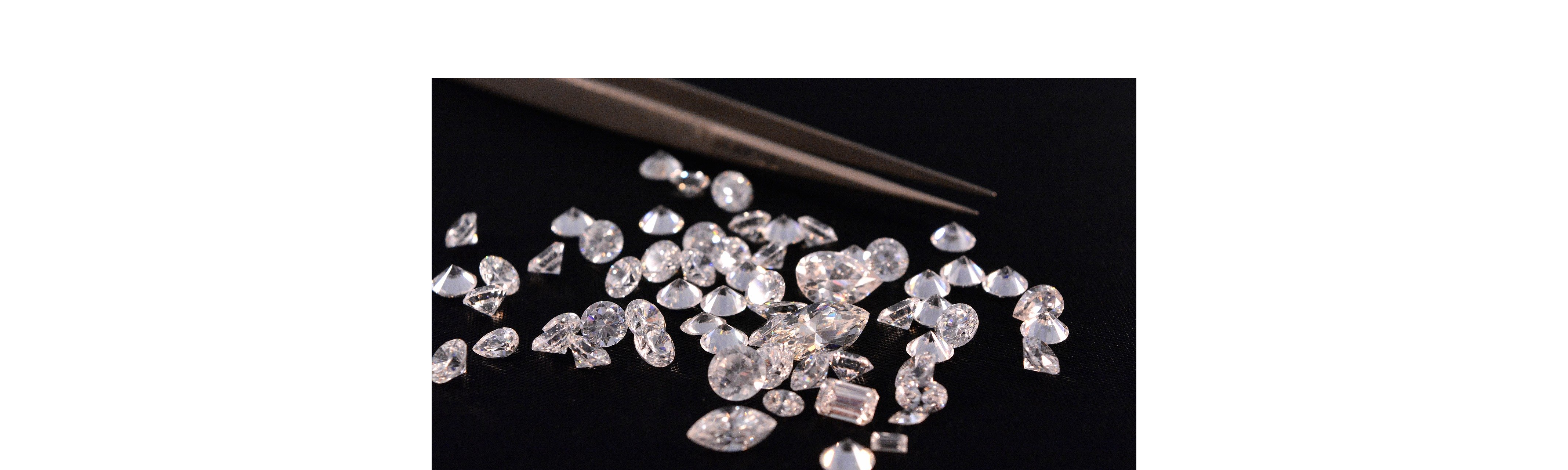


DIAMONDS
Name: The word “diamond” comes from the Greek word “adamas” meaning ‘unconquerable’, ‘indestructible’, ‘invincible’, or ‘unbreakable’.
Chemical Composition: C (carbon).
Color: Diamond gets its color from nitrogen, boron, hydrogen, natural radiation, and crystal distortion. Diamonds have a color range that includes colorless, yellow, brown, gray, green, blue, pink, red, orange, violet, and black. Before an industry standard the terms “river or water” were used to describe the most colorless diamonds and the term “Cape” to describe pale yellow diamonds. Diamonds that are colorless or pale blue are rare and sought after. Most gem diamonds are tinged with yellow. Most industrial diamonds are gray or brown. Today, the most sought-after color of Diamond is the rare natural red diamond and the canary yellow diamond.
Treatments: These treatments are used to improve color and/or clarity.
Laser Drilling: to remove inclulsions.
Fracture Filling: Using lead-glass to hide fissures.
High Pressure & High Temperature (HPHT): To improve or change color.
Heat & Irradiation: to improve or change color and/or clarity.
Coating: To improve or change color.
Moh’s Hardness: 10.
Toughness: Excellent. However, it has “perfect octahedral cleavage” meaning it can split of struck precisely at the right angle.
Location Found: India, Brazil, South Africa, the Democratic Republic of Congo (Zaire), Botswana, Russia, Australia, China, Canada, and the United States of America. Diamonds are found in alluvial gravels, glacial tills, and kimberlite pipes.
Birthstone: April.
Wedding Anniversaries: 60th and 75th .
Zodiac Signs: Aries, Leo, Libra, Taurus.
Chakra Associations: Crown.
Historical Associations: : clarity; strength; love; marriage; ward off the evil eye; healing; longevity; strength; beauty; happiness; courage; commitment; purity; purification; eternity; passion; wealth; prosperity; power; protection in battle; invincibility; authority; unbending will; stars; lightning bolt; amplify energy; breakthrough spiritual obstacles; breakthrough mental blocks; see truth in complicated situations; manifestation.
Historically Used to Treat: neutralize poison; protect against the plague; insanity; fear; delusions; high anxiety; wasting illness; strengthen internal organs; skin rashes; acne; fungal infections; mental blocks.
Imitations: Cubic Zirconia (CZ), Moissanite, White Sapphire, White Zircon, and Glass.
Synthetics: Chemical Vapor Deposition (CVD), High Pressure High Temperature (HPHT). These are chemically and physically identical to natural diamonds.
The 4 Cs: The Term 4 Cs was coined in 1939 by Robert Shipley, the founder of GIA, to help his students remember the four factors used to describe a faceted diamond. Richard Liddicoat succeeded Robert Shipley and established GIAs Clarity and Color Scales which are universally utilized.
- Carat Weight:
Originally carob seeds were used as counterweights in their balance scales to help determine carat weight. Diamonds are weighed in carats and in points (1 carat = 200 milligrams and 1 point = 0.01 carat). Carat weight measures how much a diamond weighs. - Clarity: Richard Liddicoat established the GIA Clarity Scale resulting in several grades from FL-to-I. They are: Flawless (FL) = no inclusions or blemishes visible under 10x magnification. Internally Flawless (IF) = no inclusions visible under 10x magnification. Very, Very Slightly Included (VVS1, VVS2) = inclusions so slight they are difficult for a skilled grader to see under 10x magnification. Slightly Included (SI1, SI2) = inclusions are noticeable under 10x magnification. Included (I1, I2, I3) = inclusions are obvious under 10x magnification and may affect the transparency and brilliance of the diamond. To the naked eye VS1 and SI2 may look the same.
The size, position, and visibility of inclusions can have a significant impact on diamond clarity. - Cut: A properly cut diamond will appear more brilliant due to its well-cut facets and how they interact with light. Its proportions, symmetry, and polish all play a factor. Brightness refers to the internal and external white light reflected from a diamond. Fire refers to the scattering of white light into all the colors of the rainbow. Scintillation refers to the amount of sparkle a diamond produces, and the pattern of light and dark areas caused by reflections within the diamond. The grade of the cut also considers the design and craftsmanship, weight relative to the diameter, girdle thickness, the symmetry of its facet arrangement, and the quality of polish on those facets. The pavilion depth affects the light play within the diamond. The earliest form of diamond cutting is the ‘point cut’ which has eight symmetrical facets in the shape of an octahedron. The ‘table cut’ improved the ‘point cut’ by cutting off the top half to create a table. In 1919 Marcel Tolkowsky developed the ideal cut diamond proportions with the modern brilliant and ideal cuts.
- Color: Richard Liddicoat developed the now universally utilized D-to-Z color scale which is based on the absence of color and measures the degree of colorlessness by comparing the diamond to ‘master stones’ of established color value under controlled lighting and precise viewing conditions. A chemically pure diamond has no hue. Naturally colored diamonds that are not in the normal color range are called ‘fancy-color’ and are either yellow or brown with more color than a ‘Z’ master stone or are a color other than yellow or brown.
Care: Clean your diamond periodically as diamonds attract skin oils and they lose their sparkle quickly. Ultrasonic and steam cleaning is generally safe, provided the stone is not fracture-filled (the glass filling can be damaged). Clean with warm, soapy water and a soft brush. Make sure to thoroughly rinse and dry your diamonds.
Diamonds can be chipped by a sharp, sudden blow, especially when doing rough work so be sure to take them off. Diamonds can scratch every other gemstone, so store them in separate pouches or compartments to protect your other jewelry.